
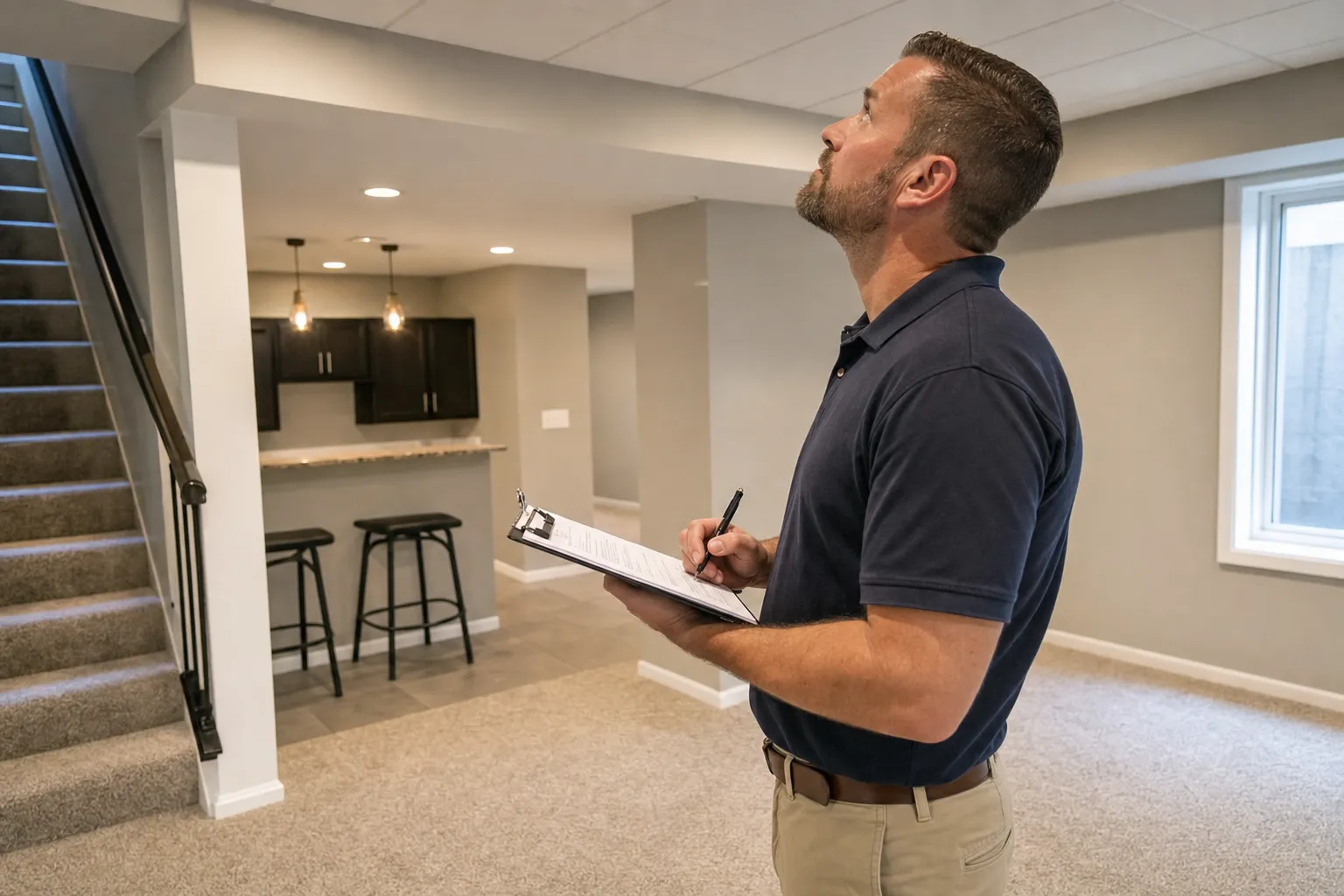
Yes, finishing your basement will increase your property taxes in Brownsburg. The Hendricks County Assessor adds legally finished, permitted square footage to your home's assessed value, which raises your annual tax bill. The trigger is the building permit: once a final inspection confirms the work is complete and code-compliant, the assessor updates your property record. The size of the tax increase depends on your current assessed value, the finish level you choose, and the local millage rate set by Hendricks County taxing districts each year. Contacting the Hendricks County Assessor before you finalize your plans is the best way to understand how your specific scope will affect your annual tax obligation.
How does finishing a basement affect assessed value in Indiana?
Finishing a basement raises your home's assessed value because Indiana assessors treat finished square footage differently than unfinished storage space. The state uses a cost-based mass appraisal system. Finished living space carries a higher per-square-foot value than raw, unfinished basement area under that system.
The Hendricks County Assessor updates your property record after a building permit inspection confirms the work is complete and code-compliant. Unfinished basements are assessed at a lower rate, so converting that space to livable square footage creates a measurable jump in assessed value.
This is a statewide rule, not a local Brownsburg policy. The Hendricks County Assessor applies Indiana property assessment guidelines published by the Indiana Department of Local Government Finance. Those guidelines set the framework; the local assessor applies it to your specific parcel.
What counts as "finished" in the assessor's eyes?
The assessor looks for a defined set of conditions before classifying a space as finished living area. A room generally needs to meet conditions related to ceiling height, egress, conditioned air, and electrical installation to qualify. Check those specifics directly with the Hendricks County Assessor's office, since classification details can vary. A framed and drywalled room that lacks egress or conditioned air may still land in the partially finished or unfinished category. The assessor makes that call based on what the field review confirms, not what you or we think it should be.
What triggers a reassessment in Hendricks County?
Pulling a building permit for your basement finish is the main thing that puts your parcel in front of a reviewer in Indiana counties. When a permit is issued and a final inspection is completed, assessors are notified of the improvement and schedule a review of your property.
A field appraiser may visit after the final inspection to verify the finished condition and update the property record. Contact the Hendricks County Assessor's office directly to understand their specific process for reviewing permitted improvements.
Hendricks County also conducts periodic general reassessments of all properties, as required under Indiana law. A permit event can move your specific parcel to the front of that line rather than leaving it to wait for the next county-wide cycle. Sale of the home is another common reassessment trigger, but a basement finish during ownership is most often flagged by the permit record.
The permit isn't optional anyway. It protects you legally, confirms the work meets code, and gives future buyers confidence. The reassessment that follows is simply the county catching up with the improvement you made.
How does the Hendricks County Assessor calculate finished basement value?
The Hendricks County Assessor uses Indiana's cost-based guidelines to assign a per-square-foot value to your newly finished basement space. Assessors apply grade and depreciation factors, so a basic finish and a high-end finish may result in different assessed values even at identical square footage.
When grading your finished basement, the assessor looks at the square footage of the newly finished area, the finish grade (basic, average, or above-average materials and workmanship), and any amenities like a full bathroom, wet bar, or kitchen area. All of those push the grade higher. Indiana assessment guidelines may also apply a below-grade adjustment, meaning finished basement space can be valued differently than above-grade living area.
Does a basement bedroom count the same as an above-grade bedroom for assessed value?
Under Indiana assessment guidelines, below-grade finished space may be assessed differently than above-grade living area. A finished bedroom in your basement adds real assessed value, but Indiana's assessment framework may apply a below-grade factor. We'd call the Hendricks County Assessor directly to understand how your specific space will be classified before you set your budget expectations.
The assessor's calculation is not the same as a real-estate appraisal. Market value and assessed value often differ, sometimes by a wide margin. Homeowners can review their property card on the Hendricks County Assessor's public portal to see how a space was classified after a reassessment is complete.
Does skipping a permit let you avoid a property tax increase?
Skipping a permit does not reliably protect you from a tax reassessment. It also creates serious legal and safety risks. An assessor or appraiser who visits the property for any reason, including a sale or an inquiry tied to a neighboring permit, can note the finished space and update the property record.
Unpermitted work can complicate a home sale. Finished space without permits may be flagged during buyer due diligence, and that's usually the worst possible moment to sort it out. Homeowner's insurance coverage for that space may also be affected when the work was done without a permit, so consult your insurer for specifics. Building code enforcement authorities may require inspection of unpermitted work if it's discovered, and in some cases the work may need to be brought into compliance, adding significant cost on top of what you already paid.
Code-violation fines are another real consequence. The financial exposure from fines, potential remediation, and a complicated sale process far outweighs any short-term tax savings from skipping the permit. The permit process exists to protect you as much as the public. Working within it is the only approach that keeps your investment secure.
How much will my property tax bill actually go up?
The exact increase depends on your current assessed value, the local tax rate, and how the assessor grades your finished space. No universal dollar figure applies to every home or every finish scope.
Here is how the math works: the assessor adds a dollar amount of assessed value based on your finished square footage and grade. That added assessed value is then multiplied by the local millage rate to produce the added annual tax. Indiana's homestead deduction and other exemptions apply to the whole property, which can soften the net tax increase for owner-occupants who live in the home full time.
What is Brownsburg's current property tax rate?
Local tax rates in Brownsburg are set annually by Hendricks County taxing districts, not by the town alone. The rate changes from year to year. The most current rate is available directly through the Hendricks County Auditor's office or the Hendricks County Assessor. Check with one of those offices before you start your project so you have an accurate number to plug into your budget. Don't rely on rates from previous years. The figure shifts with each budget cycle.
When should you contact the Hendricks County Assessor before starting your basement?
Contact the Hendricks County Assessor before you finalize your basement plans, ideally while you're still comparing scope options. Knowing the likely assessed-value increase lets you weigh the added tax cost against the finished space's contribution to your budget and home value before you commit to a contractor or a design.
The assessor's office can explain how different finish levels affect the property record. A simple recreation room and a full in-law suite with a kitchenette and bathroom will land in different assessment grades, and that difference translates to different tax outcomes. You can also review comparable finished-basement assessments on the Hendricks County Assessor's public property portal. Searching similar homes in your neighborhood shows you what other finished basements carry in assessed value, which gives you a reasonable benchmark before your appraiser ever visits your property.
Does finishing a basement increase home value more than it increases taxes?
For many homeowners, finishing a basement can add more to the home's market value than the resulting annual tax increase. Assessed value and market value are different numbers. Even when the assessed value rises, the annual tax increase is only a fraction of that assessed-value figure, not a fraction of the market-value gain.
Finished basements appeal to buyers looking for extra living space, whether for a dedicated playroom, a home office, or a guest suite. Those are the same reasons most of our customers start the conversation with us in the first place. The value a finished basement adds depends on finish quality, neighborhood, and market conditions at the time of sale. Outcomes vary by home and circumstance.
If you want to understand how finishing a basement affects your tax bill and home value in Brownsburg from scope selection through the permit process, our full basement finishing guide walks through every stage of the decision.
The Bottom Line
A permitted basement finish in Brownsburg will increase your assessed value and raise your annual property taxes through the Hendricks County Assessor. Call the Hendricks County Assessor before committing to your scope, and don't skip the permit to dodge the tax increase. We've seen what unpermitted work costs homeowners at resale, and it's never the savings they expected.