
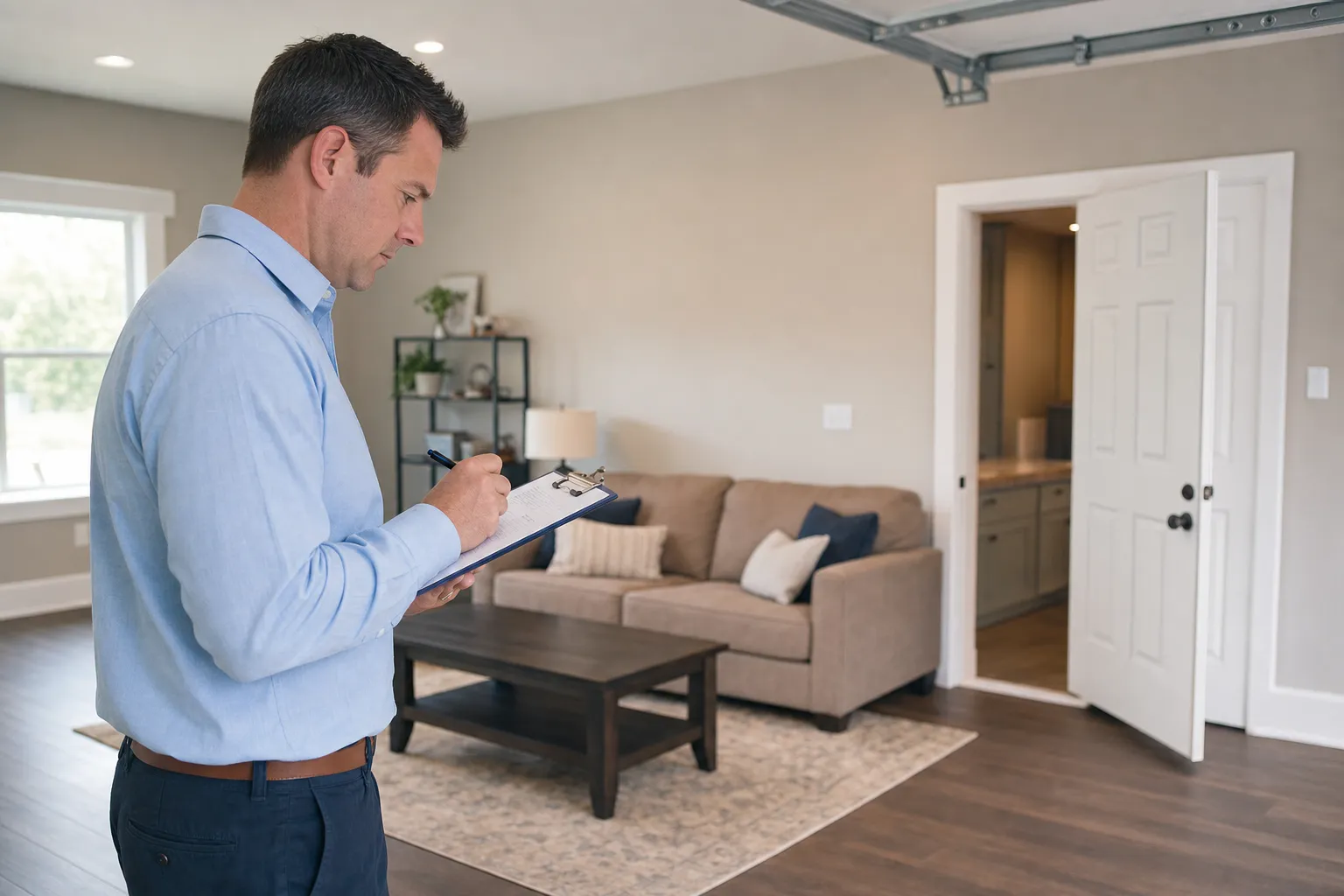
Will my property taxes in Brownsburg definitely go up after a garage conversion? Most likely yes, but "definitely" overstates it. The Hendricks County Assessor reviews permitted work and may reclassify your garage from unfinished space to finished living area. That reclassification raises your assessed value per square foot, which raises your annual tax bill. The exact increase depends on the size of the conversion, the finish level, and Hendricks County's current tax rate. Indiana's homestead deduction softens the impact but doesn't eliminate it. The tax increase also doesn't appear on your bill immediately. It typically follows the assessor's next review cycle after your permit inspection closes. Several variables shape the final outcome, so no single number applies to every Brownsburg home.
What does "reclassification" mean for your Brownsburg home?
Reclassification means the Hendricks County Assessor changes how your square footage is categorized on the property record, from garage to finished living space. That category shift is the event that drives a higher assessed value, not the construction work itself.
Garages are assessed at a lower rate per square foot than finished rooms. The reason is straightforward: an unfinished garage lacks insulation, conditioned air, and interior wall finishes. The assessor reflects that lower utility in a lower per-square-foot value.
Once a conversion adds insulation, HVAC supply, drywall, and flooring, and a building permit is pulled to cover that work, the assessor updates the property record to reflect those upgrades. That single category change can raise your home's total assessed value even though you didn't build an addition or expand the footprint.
The change is not automatic on the day construction is complete.
Does a permit automatically trigger a reassessment in Hendricks County?
Pulling a building permit can alert the Hendricks County Assessor's office that work was done, prompting a review that may be a physical inspection or a records update based on the permit description. The review happens on the assessor's timeline, not yours. The gap between permit closeout and updated tax record can range from a few months to the next annual reassessment cycle.
How does the Hendricks County Assessor calculate the new value?
Indiana assessors generally use a cost-based approach that assigns a dollar value per square foot based on the property's use type and finish quality, though the specific methodology applied in Hendricks County should be confirmed with the assessor's office directly. Finished living area carries a higher per-square-foot value than an attached garage. Converting 400 square feet of garage space adds that differential to your assessed total.
The assessor also considers overall condition, age, and neighborhood sales data when setting the final value. Indiana law requires assessors to reflect market value in use, so comparable home sales in Brownsburg influence the outcome alongside the cost model.
You can contact the Hendricks County Assessor's office to request your current assessment record and see how each space is classified. Honestly, checking that record before you start a project is one of the most useful things you can do. It gives you a real baseline, not a guess.
What finish level triggers the highest reclassification in Brownsburg?
Adding a full bathroom, kitchen, or bedroom-grade finishes pushes the converted space into the highest residential finish tier. The assessor evaluates finish quality in layers. Here are the four typical upgrade tiers:
- Unfinished: concrete floor, exposed framing, no HVAC; assessed at the lowest garage rate.
- Semi-finished: insulated walls and basic flooring, but no HVAC or plumbing; partial step up in assessed rate.
- Finished: drywall, flooring, conditioned air, and electrical to code; assessed as standard living area.
- Premium finished: full bathroom, kitchen elements, or high-grade materials; assessed at the highest residential finish rate.
Each step up the tier list increases the per-square-foot value the assessor assigns to that space.
Are there situations where taxes might not go up after a garage conversion?
Yes. A few scenarios can limit or delay a tax increase, though these are the exception rather than the rule in Brownsburg.
If a conversion is done without a permit, the assessor may not learn of it until the next physical inspection or a property sale. We want to be direct here: unpermitted work carries its own legal risks and is not a reliable strategy for avoiding reassessment. It tends to surface at the worst possible moment, usually when you're trying to sell.
If your home's assessed value is already near or above the neighborhood market ceiling, the assessor has less room to raise it further. The cost approach still applies, but comparable sales data acts as a natural cap on how high the assessed value can go.
Minor conversions that stop short of adding HVAC, insulation, or finished walls may not trigger full reclassification to finished living space. A basic workshop or storage-room upgrade looks different on the permit and on the assessor's record than a bedroom suite does.
Indiana's homestead deduction doesn't prevent a reassessment, but it does reduce the taxable portion of your assessed value. The net tax jump may be smaller than the gross assessed-value increase suggests, depending on the deduction amounts in place at the time.
One honest tradeoff worth naming: avoiding a permit to sidestep taxes creates legal exposure. Unpermitted work can complicate a future home sale, delay a refinance, and leave you responsible for code violations discovered at closing in Hendricks County.
How much could your assessed value actually increase in Brownsburg?
The assessed value increase varies by home size, finish quality, and local market conditions. No single number applies to every Brownsburg property.
Assessed value and appraised (market) value are related but not identical. Indiana assessors target market value in use, so a meaningful appraisal gain from a garage conversion often leads to a meaningful assessed-value gain as well. The two figures move together even though they're produced by different methods.
A two-car garage conversion to a finished bedroom-and-bath suite adds more square footage at a higher finish tier than a simple storage-room upgrade. The tax impact scales accordingly. Larger footprint, higher finish level, larger assessed-value increase.
We'd encourage you to request a copy of your property record card from the Hendricks County Assessor before and after the project. Comparing the two cards shows exactly which category changed and by how many square feet. That's the clearest way to verify the reassessment was applied correctly, and it puts you in a much stronger position if you ever need to appeal.
For a broader look at how the size, permit type, and finish level of a garage conversion all connect to your final tax outcome, the full breakdown of whether a garage conversion raises property taxes in Brownsburg and by how much walks through each factor in sequence.
What is the Indiana homestead deduction and does it help after a conversion?
Indiana's homestead deduction reduces the net assessed value on which your property tax bill is calculated. That reduction softens, but doesn't eliminate, the tax impact of a garage conversion.
If you already claim the homestead deduction on your Brownsburg home, the deduction carries forward after a conversion. You don't need to reapply simply because you remodeled. The deduction applies to the property, not to the specific configuration of rooms.
The deduction covers a set percentage of assessed value plus a supplemental cap established by Indiana law. A higher assessed value still produces a higher tax bill because the deduction reduces the base by a fixed formula, not by a fixed dollar amount that grows with your value.
Does converting a garage to an ADU change my homestead status in Indiana?
Potentially yes, and this is a part of the conversation we think more homeowners should have before they finalize their plans. Homeowners who convert a garage into a separate dwelling unit (an ADU) and then rent that unit may lose homestead eligibility if the property is no longer classified as a single-family owner-occupied residence. The homestead deduction in Indiana is tied to owner occupancy of the primary residence, and adding a rentable unit can change how the property is classified.
Consulting the Hendricks County Assessor before completing an ADU conversion is the right step. The assessor can tell you how the proposed use would affect your classification before you commit to that finish plan.
For authoritative detail on Indiana deduction rules and eligibility requirements, the Indiana Department of Local Government Finance publishes current guidance at Indiana property tax deductions explained.
When will you actually see a higher tax bill after the conversion?
The higher bill typically appears in the tax year that follows the assessor's updated record, not immediately after construction is complete. Indiana property taxes are paid in arrears, so there's usually a lag of several months to over a year between the permit inspection and the first elevated bill.
The Hendricks County Assessor's office sends a Notice of Assessment Change when your property's value is updated. Watch for that document in the mail after your project closes. That notice is your first signal that reclassification has occurred. Don't let it go to the bottom of the pile.
Hendricks County issues property tax bills on a schedule set by the county. Contact the Hendricks County Treasurer's office to confirm current billing dates. The first bill to reflect the new assessed value confirms the reclassification is on the books.
How do I appeal my Hendricks County assessment after a garage conversion?
If the Notice of Assessment Change shows a value you believe is incorrect, Indiana law gives you the right to appeal. The deadline is typically 45 days from the notice date. Here is the basic process:
- Receive your Notice of Assessment Change and record the date it arrives.
- Compare the new assessed value to recently sold comparable homes in your Brownsburg neighborhood to judge whether the value is in line with market evidence.
- File a Form 130 petition with the Hendricks County Property Tax Assessment Board of Appeals before the 45-day window closes.
Filing the appeal doesn't guarantee a reduction, but it does open a formal review where you can present evidence that the new value is out of step with comparable properties.
Is the long-term equity gain worth the higher taxes in Brownsburg?
For many homeowners, weighing the tax cost against the value added by finished living space is a central part of the decision. Whether that tradeoff works in your favor depends on the scope of work, local market conditions at the time of a future sale, and how long you plan to stay in the home.
Finished, conditioned square footage is generally valued differently than unfinished garage space in residential real estate, though the specific impact varies by market and buyer.
A modest annual tax increase is a recurring cost. Any value gain from the conversion is realized when you sell or refinance, and how much that gain matters depends on market conditions at that time.
Homeowners who plan to stay long-term or use the converted space may spread the tax cost across many years, which can make the tradeoff more favorable. Those planning to sell within one or two years should weigh closing costs, market timing, and buyer demand for converted spaces in their specific Brownsburg neighborhood before committing to the project.
Here's the thing: the right answer is personal. Run the numbers using your actual assessed value, Hendricks County's current tax rate, and a realistic resale estimate before deciding whether the project pencils out. We're happy to talk through the scope side of that equation with you.
The bottom line
A garage conversion in Brownsburg will most likely raise your property taxes because the Hendricks County Assessor reclassifies finished living space at a higher assessed rate than an unfinished garage. The increase isn't instant. It follows a permit inspection and the assessor's review cycle, and Indiana's homestead deduction reduces the net impact on your bill. Whether the value added by finished square footage outweighs the recurring tax increase depends on your specific project scope, local market conditions, and how long you plan to stay in the home. To see the full picture of variables that shape your outcome, read our guide on whether a garage conversion raises your Brownsburg property taxes and what controls the size of that increase.