
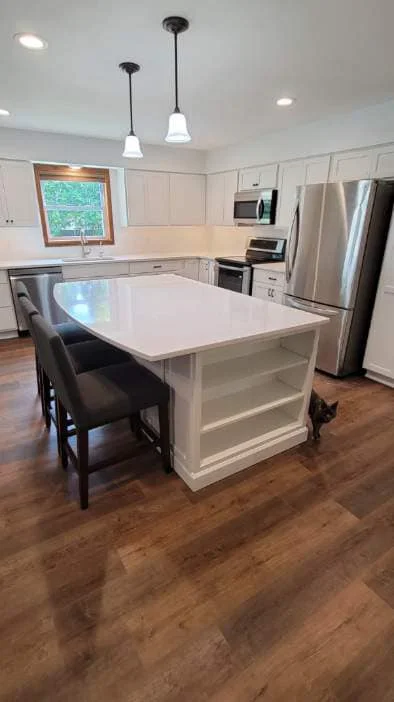
What a $30,000 Kitchen Remodel Typically Includes
A $30,000 budget usually covers a solid mid-range kitchen remodel that keeps your current layout. Think new cabinets, countertops, backsplash, flooring, lighting and fixtures. Moving walls or plumbing is where that budget starts to stretch thin.
Here's the honest picture for a Brownsburg kitchen. Thirty thousand dollars buys a real upgrade. It won't buy a gut-and-rebuild. The key word is layout. Keep your sink, range and fridge where they are, and the money goes into the things you see and touch every day.
Most projects at this level include some mix of the upgrades below. The exact blend depends on your kitchen size. It also depends on what bugs you most about the space right now.
- New semi-custom cabinets, or painted and refaced boxes if yours are still solid
- Quartz or granite countertops with an undermount sink
- A tile backsplash running the length of your counters
- Luxury vinyl plank or tile flooring that can handle Indiana mud season
- Better lighting, such as recessed cans and under-cabinet strips
- Smaller finishing touches like a new faucet, fresh paint and new hardware
Appliances are the wild card. Some homeowners fold a mid-range package into the budget. Others keep what they've got and put that money into better cabinets. Both choices make sense.
The team sees the same kitchen over and over in Brownsburg subdivisions built in the '90s and early 2000s. Builder-grade oak cabinets. Laminate tops. One dome light in the middle of the ceiling. Those kitchens are great candidates for this budget, the bones are usually fine.
So what pushes a project past $30,000? Almost always it's something behind the walls or under the floor. Knocking out the wall to the dining room. Moving the sink to an island. Running a new gas line so the range can sit somewhere else. Each change brings in more trades and more permit work.
And here's something most people don't know until demo day. Lots of Brownsburg homes sit on concrete slabs. Moving a sink drain on a slab means cutting into the concrete and patching it back. That one change can eat a big chunk of your budget fast.
One couple near Arbuckle Acres Park came in set on an island with a sink. Their kitchen sat right on a slab. They kept the sink on the outside wall under the window. The money they saved went into a bigger island with seating for four. They stayed on budget and ended up with more counter space than they'd planned.
Layout drives cost more than finishes do.
But where you spend matters just as much as how much. A cheap cabinet box under a fancy countertop won't hold up. The doors sag and the shelves bow. Solid cabinets with a mid-range quartz top will look good for years and years. Spend on the parts that take daily abuse. Save on the parts you can swap out later, like light fixtures or hardware.
Call nowWhy Two $30,000 Kitchens Can Look Completely Different
Picture two kitchens on the same street in Brownsburg. Both owners spend about $30,000. One kitchen looks brand new from floor to ceiling. The other looks nicer, sure, but still feels a lot like the old one.
So what happened?
It's rarely about one family getting a better deal. It's about where the money went. A kitchen remodel budget gets split between what you see and what you don't. And the part you don't see can eat more than you'd expect.
The team sees this all the time. One neighbor keeps the sink and stove right where they are. The other moves the sink to a new island. That single choice means new plumbing lines, a new drain, possibly new electrical, and floor work under the island. Same budget, very different finish.
Here are the biggest things that pull a kitchen remodel budget in different directions:
- Moving plumbing, gas, or vent lines instead of keeping the current layout
- Full new cabinets versus refacing or painting the boxes you already have
- Countertop material, since some stones need more fabrication and seams
- What's hiding behind the walls once the old cabinets come down
- How many finishes you upgrade at once, like flooring, lighting, and backsplash
Look at that list again. Only a few of those items show up in a photo. The rest is labor and materials that make the kitchen work right for the next twenty years.
Hidden conditions matter more in some homes than others. Plenty of houses around Brownsburg were built in the 1970s and 1980s, especially closer to the older parts of town. Those kitchens often have undersized wiring for today's appliances. Some have subfloors softened by a slow leak under the sink nobody noticed. You can't plan around a problem you can't see, that's why the team always opens up a little room in the budget before work starts.
Newer homes in subdivisions off Ronald Reagan Parkway tend to have fewer surprises. But they come with their own trade-off. Builder-grade cabinets in those homes often aren't worth saving, so more of the budget goes to replacing them.
Not every dollar needs to show.
Here's a real pattern from the field. A homeowner spends heavily on a showpiece countertop, then runs short on lighting. The counter is gorgeous. But the room still feels dim and cramped at dinner time. Good under-cabinet lighting and a smart layout often change how a kitchen feels more than any single material. Most people don't realize this until the project's done -
The point is simple. A $30,000 kitchen remodel isn't one thing. It's a set of choices. The homeowners who end up happiest decide early what matters most to them, then protect that part of the budget. Maybe it's storage. Maybe it's an open layout. Maybe it's just getting rid of the cabinets that have bugged you for ten years.
Quality work lasts longer than trendy finishes, every time. A solid layout with well-built cabinets will still feel right long after this year's popular color fades.
Call now
How to Prioritize Your Budget If $30,000 Falls Short
Finding out your wish list costs more than your budget stings. It happens in almost every first meeting. But a short budget doesn't mean a bad kitchen remodel. It means you have to pick what matters most and protect it.
Here's the rule the team follows. Spend first on the things that are hard to change later. Save on the things you can swap out in a weekend.
That one idea sorts out most of the hard choices. Use this order when you rank your list:
- Fix what's behind the walls first. Wiring, plumbing, and venting should be safe and up to code before anything pretty goes in.
- Keep the layout if you can. Leaving the sink and range where they are saves a lot of plumbing and gas work.
- Put real money into cabinet boxes. They take the most daily abuse, and cheap boxes sag and swell near the sink.
- Pick a solid countertop that fits your cabinets. You'll touch it every day for years.
- Leave lighting, hardware, and backsplash for last. These are easy upgrades down the road.
Notice what's at the bottom of that list. The fun stuff. That's on purpose.
The team sees the same mistake all the time. A homeowner falls for a fancy faucet or a tile wall and trims the cabinet budget to pay for it. Two years later the drawer bottoms are bowing, the faucet still looks great.
So where can you safely save? There are a few places that won't hurt you long term.
- Refacing or painting cabinets that are still solid instead of tearing them out
- A simple backsplash now, with nicer tile added in a later phase
- Mid-range appliances that you can upgrade one at a time as they wear out
- Standard cabinet sizes, since custom widths add cost fast
None of these choices lock you in. You can always add the upgrade later without ripping out good work.
Phasing the project is the other smart move. Do the plumbing and electrical rough-in now for the island you want someday. Run the wiring for under-cabinet lights even if the fixtures wait a year. And when the walls are already open, that prep work costs far less than it will later.
Here's a real example. A family in a 1990s two-story near downtown Brownsburg wanted new cabinets, quartz counters, an island, and new appliances. The full list didn't fit. So the team kept the layout and ran power to the future island spot. They installed good cabinets and counters, then kept the working fridge. The island came the next spring. No demo needed.
Homes around Brownsburg and Hendricks County built in the '80s and '90s often hide surprises. Undersized kitchen circuits are common. So are old shutoff valves that crack the minute you touch them. Always hold back a cushion for what turns up once the old cabinets come off the wall.
Would you rather find that out mid-project with no room to spare? Nobody would.
Not sure which items belong at the top of your own list? A walkthrough helps more than any online calculator. The team can look at your space and show you what's worth doing now and what can wait.
Call for a free estimate